By Luke Griffith, Staff Writer
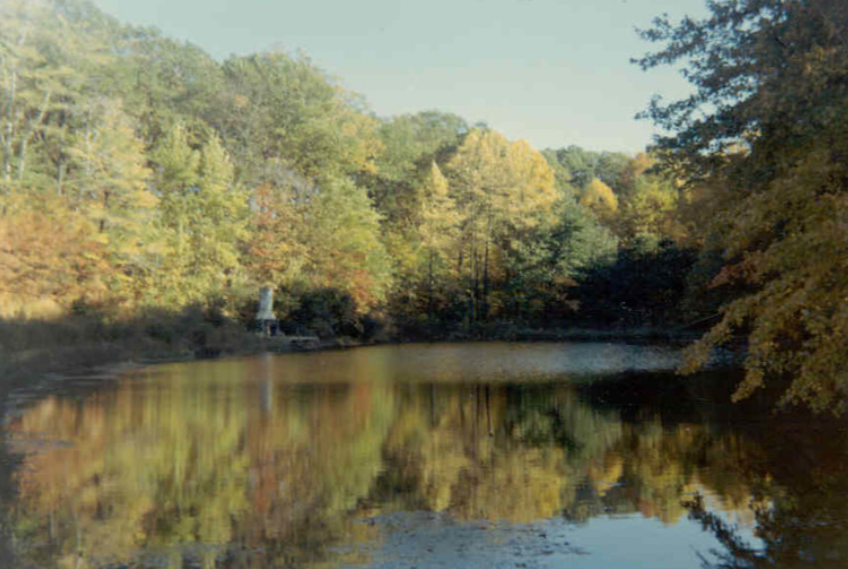
Long before Immaculata University constructed buildings like Alumnae Hall and Gabriele Library, the campus property featured a body of water that many students and faculty are unaware of today. Mary Lake served as a lively recreational piece of early campus life for students and sisters. Although many people assume the former lake site is directly behind Villa Maria Hall and Gabriele Library, it is actually across the street from the main campus property along Hershey Mill Road, behind the fields that border the maintenance building. Today, the site is now a wooded area with a steady stream that runs quietly through where the lake once was. When looking at this for the first time, there is little to suggest that the area was once filled with water, laughter, and wonderful memories. However, a closer look around the old lake site reveals concrete remains, stonework fragments, and slight changes in elevation that indicate the lake’s previous presence.
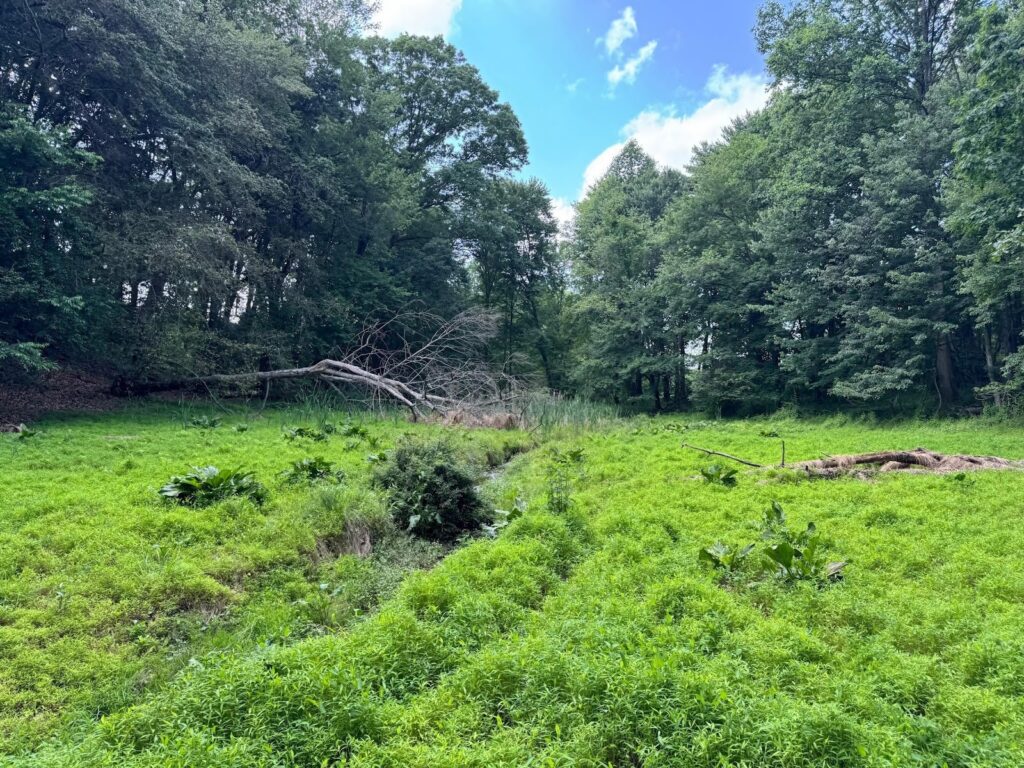
Present-Day site of the drained Mary Lake. Photo courtesy of Luke Griffith.
A Campus Retreat in the Early Years
Mary Lake was constructed around approximately the same time that Villa Maria Hall opened in 1914. According to Dr. William Watson, professor of history, the lake quickly became an important recreational outlet for students and Sisters of the Immaculate Heart of Mary. At this time, Villa Maria Hall was the only main building on campus, which meant that shared spaces like these played an important role in building community around campus. Dr. Jeffrey Rollison, executive director of Gabriele Library and longtime faculty member, also noted that early campus life was centered around accessible, inclusive shared spaces. Mary Lake provided exactly that, as students used the lake for canoeing and swimming in the summer and fall months. Then, when winter came around, it transformed into an ice skating rink. The lake existed in a time period where recreational amenities were not common, especially at a small all-women’s Catholic school. Historical accounts from Watson and Rollison suggest that the lake was deep enough to support recreational swimming and even featured a platform in the middle of the lake where students could jump off. While exact measurements are unknown, the existence of the platform indicates that it was deeper than a shallow pond. The lake served as a designated body of water for enjoyment and leisure.
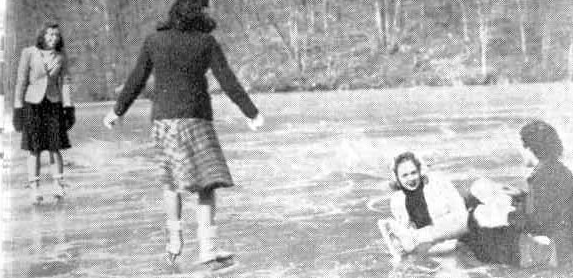
Immaculata Students ice skating on Mary Lake in 1942. Photo courtesy of Immaculata University/Gabriele Library.
The Lake House and Its Legacy
Along the base of the lake once stood a lake house that served as a gathering place for students and a storage space for canoes and other supplies. Students could also use the space to socialize with students by the water. At some point before 1967, the lake house was destroyed by a fire. However, its presence has not been entirely erased. While the fireplace has partially collapsed, the concrete foundation is still standing, and traces of a former stone walkway can still be seen alongside Hershey Mill Road. Most of the structure and the walkway are obscured by the overgrown vegetation, but it remains visible. Students continued to gather around the old fireplace structure even after the lake house had burnt down. This illustrated the deep connection that students felt to this lake over time, in addition to the foundation of the lake house. These physical remains serve as important evidence that they once played an important role in the daily life of Immaculata.
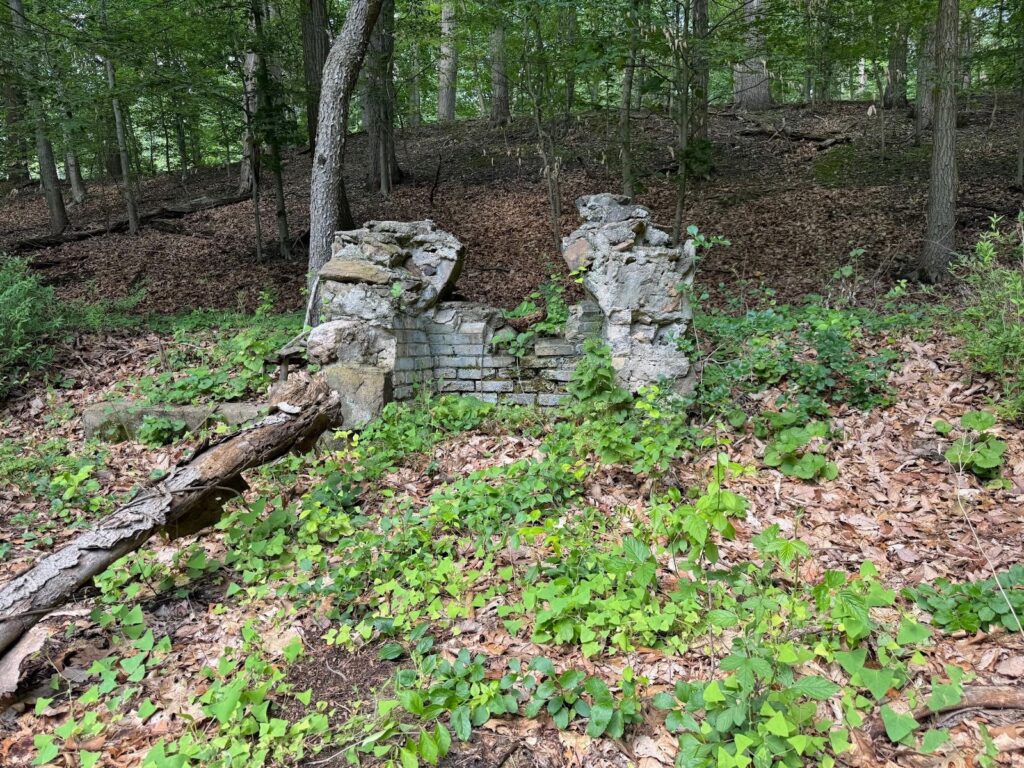
The present-day base of the lake house fireplace. Photo courtesy of Luke Griffith.
The Closure of Mary Lake
By the early 1970s, residential neighborhoods in the surrounding area behind the lake were developed, and the university expanded its operations. Liability concerns began to grow since maintaining a dam and an open body of water adjacent to a growing campus population presented more risks. As a result of these factors, the university closed Mary Lake for good. The lake was eliminated by breaching its dam. Rather than carefully tearing down the structure and restoring the land, the water was allowed to drain. Large portions of the old dam’s concrete remains are scattered throughout the wooded area today. Over the following years, nature has slowly started to reclaim the basin. Without active maintenance of the basin, sediment accumulated, and vegetation took root in the soil. The lakebed has filled in slightly over time, which has made the basin seem more shallow than it once was as a lake. The area has transformed into a wooded area with a small stream flowing through the center.
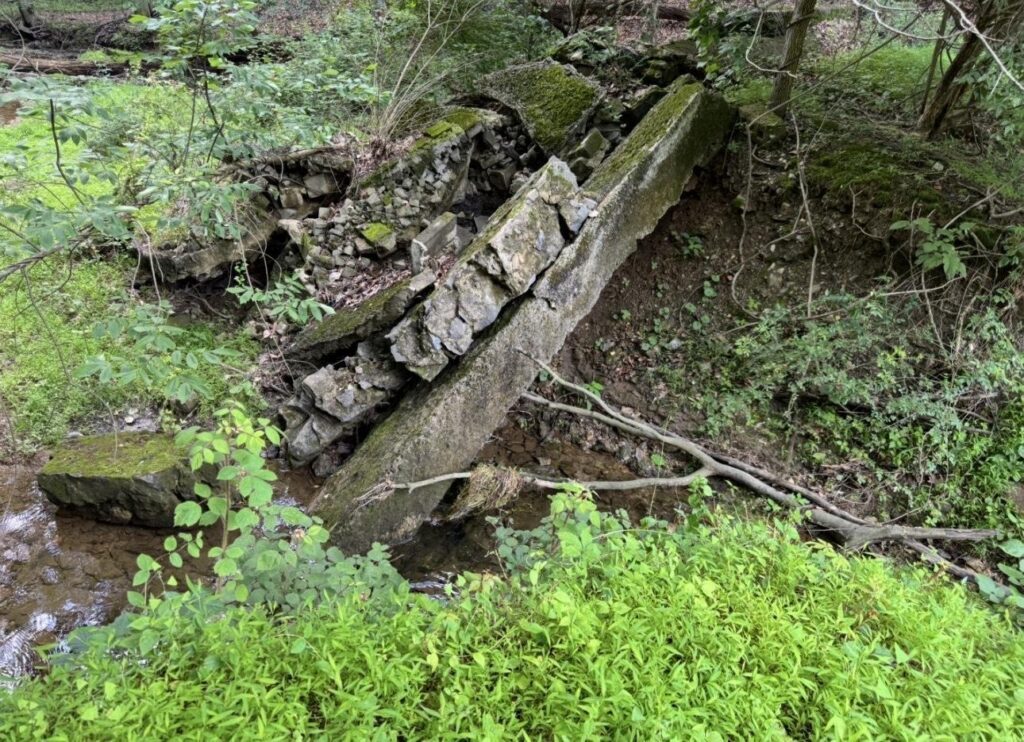
Present-day view of the Mary Lake’s dam remains. Photo courtesy of Luke Griffith.
A Forgotten Landscape
Visiting the site of Mary Lake today requires both determination and caution. As mentioned before, the area is severely overgrown and overrun with ticks in the warmer months of the year. Many people who are not aware of the lake’s existence look at this space and are unaware of what it once was. However, for those who are aware of the landscape’s past, it represents something very unique. Like the swimming pool that was once located in the terrace rotunda in Villa Maria Hall, Mary Lake represents a key piece of Immaculata’s history. It was not just a recreational feature for the campus; it was a place for students to gather, reflect, and share experiences. Mary Lake gave the students, faculty, and sisters a common place for leisure and relaxation even in its earliest days. Thanks to the recollection and insights from Dr. Watson and Dr. Rollison, as well as the physical remains that are still present today, Mary Lake has not been forgotten. The lake’s memory survives in pictures, faculty recollections, and subtle evidence that still exists in the woods today. When we remember Mary Lake, we are reminded that the campus’s history extends beyond its physical buildings. The campus’s history is embedded in the fields, forests, and waterways that were once a key element to student life. While the water was drained nearly 55 years ago, the memory of Mary Lake continues to live on each day.