By: Izzy Greiss, Staff Writer
Imagine it’s the summer of 1832. Irishman Philip Duffy has just contracted you to work on the hardest mile of the Philadelphia and Columbia Railroad, Mile 59. There are fifty-six of your peers, Irish Catholic men and women, also working on this mile. Work is tough, and the threat of cholera looms over your work, but there is an even greater threat that you cannot see ahead: the murder of your peers.
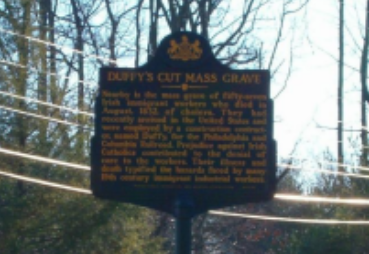
Duffy’s Cut is a historical railroad site located in Malvern, Pennsylvania within Chester County. Fifty-seven Irish Catholic workers suddenly died while working on Mile 59 of the railroad. Their deaths were originally attributed to the global cholera outbreak at the time, but a document held by the grandfather of Immaculata University Professor of History, Dr. William Watson, suggested otherwise. Further research and excavation at the site of Duffy’s Cut by Dr. Watson and his team led to the discovery of seven skeletons, all belonging to the Irish railroaders. One of the skeletons, particularly its skull, was found to have an axe wound (blunt force trauma) and a bullet hole to its head. Further testing revealed traces of iron and lead on the impacted skull, rewriting the narrative. The Irish railroaders were not suddenly killed by cholera but may instead have been massacred, and their mass grave rests where a historical placard now stands just a few miles away from Immaculata University’s campus.
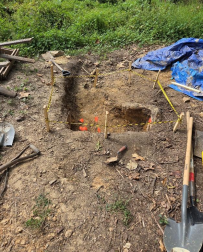
Now, Dr. Watson and his team are leading an investigation at Northwood Cemetery in Downingtown, Pennsylvania, at Mile 48 of the old railroad, where a mass grave of more than 100 Irish railroaders is suspected to lie. On September 28, 2026, I had the opportunity to interview Dr. Watson on his experience, motivation, and outlook for the Northwood excavation.
Dr. Watson learned of the Northwood location in 2003 when a local resident from Downingtown sent him a note referencing a burial of Irish Railroad workers. Watson’s team connected this account with an 1832 village record describing a man running from Duffy’s Cut in Malvern to the Downingtown location to warn workers there. Consequently, he infected them with cholera, and they all died. It is suspected that a mass grave of Irish Catholic workers exists at the Downingtown site. Watson reflects, “The Protestant workers under the McCartney brothers [in charge of Mile 48] likely escaped and blended into the local community. Our men—recent Catholic arrivals—had no advocate. Duffy himself was renting a house miles away. East Whiteland Township had about 800 residents at the time, none of them Catholic. Cholera created fear, and the men were isolated.” With the ongoing dig at the Northwood site, the narrative of the story of the Irish Catholic workers shifts from an act of violence to an act of fear—”fear of cholera, fear of contagion, and the absence of anyone willing to advocate for Irish Catholic laborers in 1832,” as Watson explains.
Watson feels strongly tied to the Irish railroaders’ story due to his own Irish heritage. His grandmother, Jane Donnely, came from an Irish family that immigrated to the United States through Canada. The family settled in Illinois in 1850, 18 years after the cholera outbreak and murders. Watson notes that his family moved constantly, resulting in his grandfather being present as a railroader in Pennsylvania with the document that led him to find the mass grave at Duffy’s Cut.
With a strong connection to his heritage, Watson feels responsible for finding the buried railroaders, identifying them, and properly returning their remains to family members or an appropriate resting place, such as John Ruddy, whose remains were identified and returned to Ireland for burial. When asked what keeps him motivated after almost 20 years of research and excavation, Watson shares that it remains clear there are still around 50 skeletons unaccounted for at the Duffy’s Cut location in addition to many other laborers located in mass burial sites in the Pennsylvania and Delaware areas. He notes the absurdity that no government agency has stepped in to help them, except for the state grant received in 2011, leaving little money for the mission today.
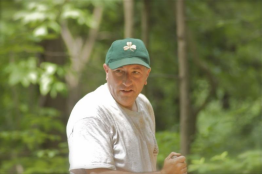
With this in mind, Watson has gathered the support of local filmmakers and editors to create a web series on YouTube titled “Grave Hunters.” Watson hopes that the immediacy of the web publications will bring greater attention to the railroaders’ story. The team continues to dig, fundraise, and bring justice to laborers of the past. Once the team has concluded its work at Northwood Cemetery, they plan to follow their next lead near a canal in Spring City, Pennsylvania.
To support the mission and help bring justice to the Irish laborers who were denied dignity in death, please consider supporting ongoing research, joining the team, contributing to fundraising efforts, and following the web series to help keep their legacy alive. As well as visiting the Duffy’s Cut Museum located in Immaculata’s Gabriele Library, which displays a number of artifacts from the original 1832 site in Malvern recovered by Dr. Watson and the Duffy’s Cut Team.
Grave Hunters Web Series: https://www.youtube.com/@gravehunting
Duffy’s Cut Websites: https://duffyscutproject.com/
Donations: https://www.paypal.com/donate/?hosted_button_id=TVLAKBWU9VQ46